
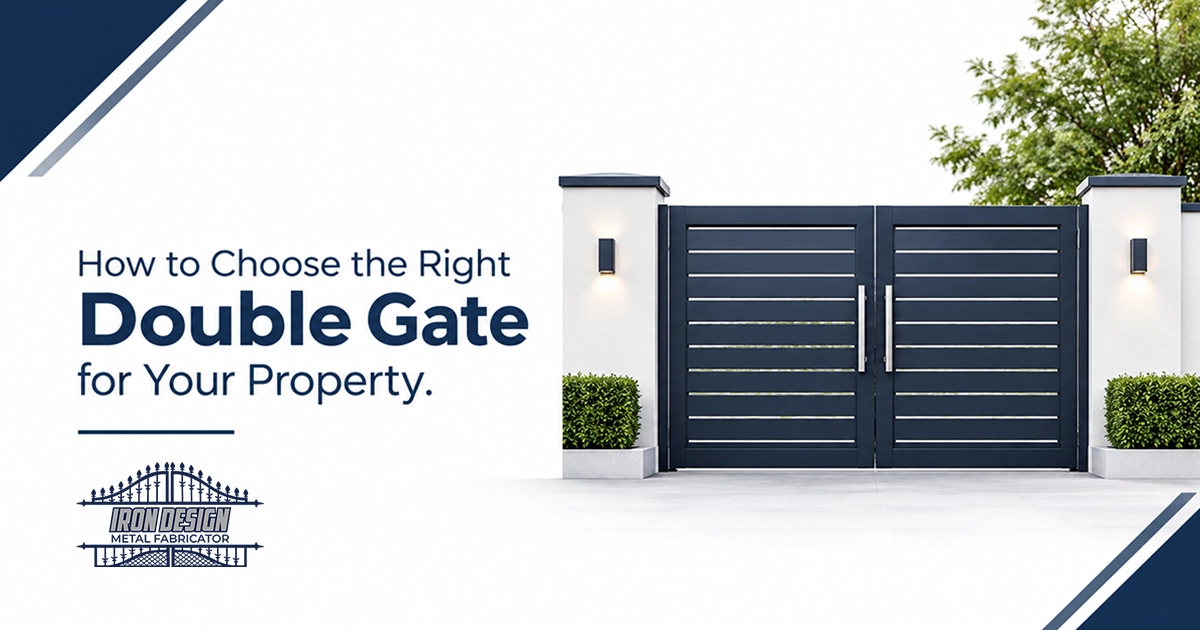
How to Choose the Right Double Gate for Your Property
Choose a double gate when your opening is wide, when you have limited room for a gate to swing, or when you want a more impressive entrance. Choose a single gate for narrower openings and walkways, or when you have clear swing space and want a simpler, usually less expensive build. Opening width, swing room, slope, and how the gate will be operated decide the answer more than style does.
Key takeaways
- A double gate splits a wide opening into two panels, so each panel needs only half the swing space of a single gate.
- A single gate has fewer parts, fewer hinges, and usually a lower cost, but it hangs its full weight on one post.
- Wide, heavy iron gates demand strong posts and deep footings, whichever style you pick.
- Automated double gates need two operators, which affects both cost and maintenance.
- Fire access rules, HOA guidelines, and local codes can decide the width before design starts, so check them early.
Ask ten homeowners why they picked their gate and you will hear about looks. Ask the installer what actually decided it and you will hear about measurements: how wide the opening is, how much room is in front of it, and whether the ground slopes.
This guide walks through those decisions so you can compare a double gate with a single gate based on your property, not just a picture.
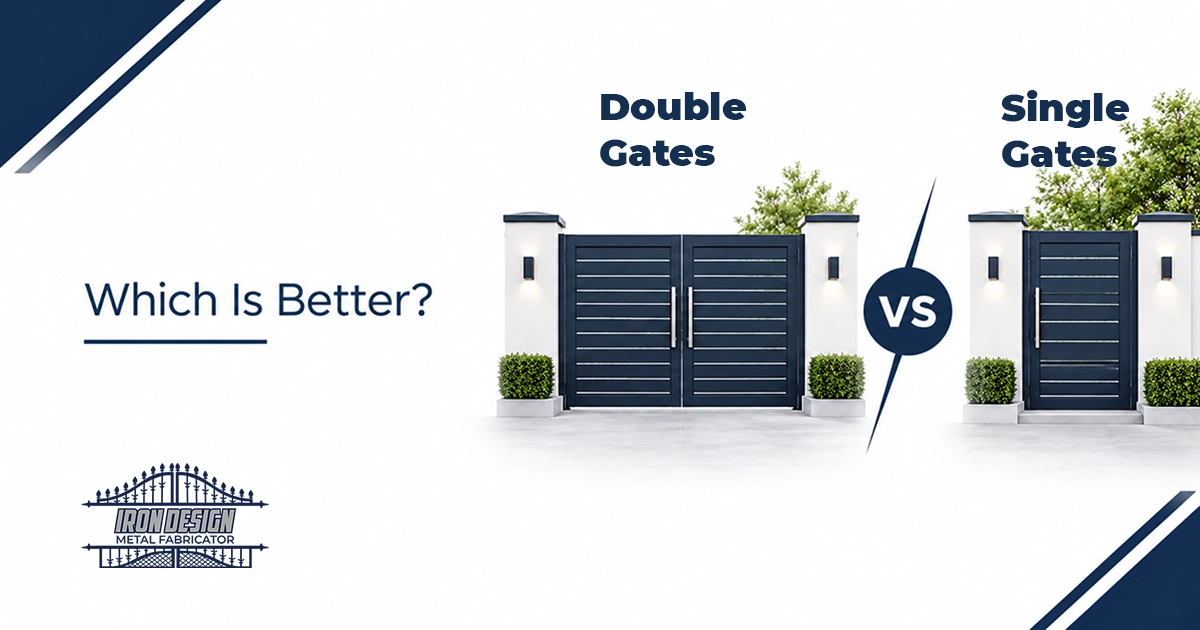
Double Gate vs Single Gate at a Glance
| Features | Single Gate | Double Gate |
|---|---|---|
| Best Opening Width | Narrower openings and walkways | Wider driveways and entrances |
| Swing Space Needed | Full gate width | Half the gate width per panel |
| Weight on Hinges | All on one post | Shared across two posts |
| Moving Parts | Fewer | More |
| Automation | One operator | Two operators |
| Typical Cost | Generally lower | Generally higher |
| Appearance | Simple and clean | Symmetrical and grand |
Sources disagree on exact limits, but a common pattern is that pedestrian gates run about 3 to 6 feet wide, and wider vehicle openings are often split into two leaves. One installer guide notes that a standard residential double gate covers roughly 12 to 16 feet, with each leaf around 6 to 8 feet, and that beyond about 8 feet per leaf the hinge and wind load begins to punish the post.
Single Gate Advantages
A single gate is not just the budget choice. It is the right choice in plenty of situations. Here are the main single gate advantages:
- Simplicity. One panel, one latch, one set of hinges. Fewer parts means fewer things to adjust or repair.
- Lower cost. Less material, fewer hinges, and, if automated, only one operator.
- Clean look. A single gate suits walkways, side yards, and smaller entrances without looking oversized.
- Easy daily use. For pedestrian access, one panel opens in one motion.
- Smaller footprint. It needs only one hinge post and one latch post.
The tradeoff is that the whole weight hangs on one hinge side, and the gate needs full swing clearance. If you want to compare options, see our single gate advantages and styles.
Double Gate Advantages
When people ask for double gate pros, these come up most often:
- Less swing space. Each panel swings only half the opening width, which helps on short driveways or tight spots.
- Better for wide openings. Splitting the opening keeps each panel at a manageable size and weight.
- Load shared across posts. Two hinge posts carry the weight instead of one, which reduces sag over time.
- Flexible use. You can open one leaf for everyday foot traffic and both for vehicles or deliveries.
- Curb appeal. The symmetrical look makes a strong first impression.
These double gate advantages come with extra hardware and more to maintain. You can see our double gate options for examples.
The Honest Downsides of Each
Single gate downsides
- A wide single gate is heavy on one hinge post and can sag if posts or footings are undersized
- Needs the full swing arc to be clear of cars, walls, and landscaping
- Harder to manage in wind when the panel is large
Double gate downsides
- More hardware, more hinges, and more adjustment points
- Automated systems need two operators, which adds cost and maintenance
- Both panels must align and latch correctly in the center, which takes careful installation
Types of Double Gates
Knowing the types of double gate helps you ask better questions. Double gate types fall into a few groups:
- By movement: Double swing gates hinge on two posts and open inward or outward. Bi parting sliding gates split in the middle and slide to each side, which suits spaces where a swing arc is not possible.
- By top line: Flat tops are clean and modern. Arched or curved tops add a traditional or estate feel.
- By infill: Open picket and ornamental designs let light and views through. Solid or privacy panels block sight lines.
- By operation: Manual gates open by hand. Automated gates use operators, access controls, and safety devices.
- By use: Driveway gates carry vehicles, while a pair of narrower double gates can also serve side yards and large patio entries.
Custom iron lets you mix these choices, so a gate can match your fence, home style, and security needs.
How to Choose: A Step by Step Process
- Measure the opening. Measure the clear width between posts, not just the gate panel. Remember that panels are slightly narrower than the opening to allow for hinges and gaps.
- Check your swing room. Mark the arc each panel would sweep. A double gate needs half the depth of a single gate of the same total width, but cars, walls, and planters still matter.
- Look at the slope. A sloped driveway can make a long single panel drag on the ground. Shorter leaves clear more easily.
- Think about what passes through. Cars, delivery trucks, trailers, and equipment each need different widths.
- Decide how it will operate. Manual is simplest. If you want automation, plan for one operator on a single gate or two on a double gate, and make sure operators are rated for the gate weight.
- Check fire access and local rules. Many fire codes set minimum clear widths where emergency vehicles must pass, and some set wider minimums for commercial or multi family properties. Electric operators on access gates are commonly required to be UL 325 listed. Confirm requirements with the City of Albuquerque or your fire marshal, and check any HOA rules.
- Plan the posts and footings. Iron is heavy. Gate posts are typically set in footings roughly 12 to 16 inches wide, with exact size depending on soil and load, and shallow footings are a leading cause of gate sag.
- Choose the style last. Once width, swing, and posts are settled, pick the top line, infill, and finish.
What Albuquerque Property Owners Should Know
Wind. Spring gusts push hard on large solid gates. Open designs let wind pass through, and strong posts and hinges keep a gate square.
Sun. Intense UV is hard on weak finishes. A quality powder coat or protective finish helps iron look good longer.
Monsoon rain. Heavy, fast rain can expose raw metal and erode soil around posts, so drainage and a sealed finish matter.
Soil and rock. Hard or rocky ground can make post holes harder to dig, and shifting soil can move a post over time. Proper footings protect the gate’s alignment.
Common Mistakes to Avoid
- Choosing the style before measuring the opening
- Forgetting to leave room for the gate to swing
- Using lightweight posts for a heavy iron gate
- Planning automation after the gate is built, instead of before
- Ignoring fire access and HOA rules until the permit stage
- Skipping a finish designed for sun and rain
Frequently Asked Questions
Is a double gate better than a single gate?
Neither is better for every property. A double gate suits wider openings and tight swing space, while a single gate suits narrower openings and simpler builds. The right choice depends on your opening width, swing room, and how you will use the gate.
How wide should a double gate be?
Many residential double gates cover about 12 to 16 feet, with each panel around 6 to 8 feet. Wider openings are possible with heavier posts and hardware. Measure the clear opening and confirm local fire access requirements before finalizing the width.
Do double gates cost more than single gates?
Generally yes, because they use more material, more hinges, and two hinge posts, and automated versions need two operators. A wide single gate that needs extra reinforcement can narrow the gap, so compare written quotes.
Do double gates need two operators if automated?
Yes. Each panel typically needs its own operator, and the two must work in sync. This adds cost and maintenance compared with a single automated gate.
Which gate is better for a short driveway?
A double gate is usually better because each panel needs only half the swing space. That helps when there is little room between the gate and the street or garage.
Do I need a permit for a gate in Albuquerque?
It depends on the height, location, and property type, and some neighborhoods add HOA rules. Confirm with the City of Albuquerque or your county and your HOA before building.
Final Thoughts
The best gate is the one that fits your opening, your swing space, and how you actually use the entrance. Measure first, check the rules, plan the posts, and choose the style last. Do it in that order and the gate will open smoothly and stay square for years.
If you are deciding between a single gate and a double gate for your Albuquerque property, the Iron Designs team can look at your opening, your posts, and your goals and tell you what will work. Call us at (505) 357-7161 or request a free estimate. You can also visit us at 249 Muriel St SE Ste D, Albuquerque, NM 87123. We build custom driveway gates and fencing and topper panels for homes and businesses in Albuquerque, Rio Rancho, Santa Fe, Bernalillo, Los Lunas, Belen, and Gallup.
