
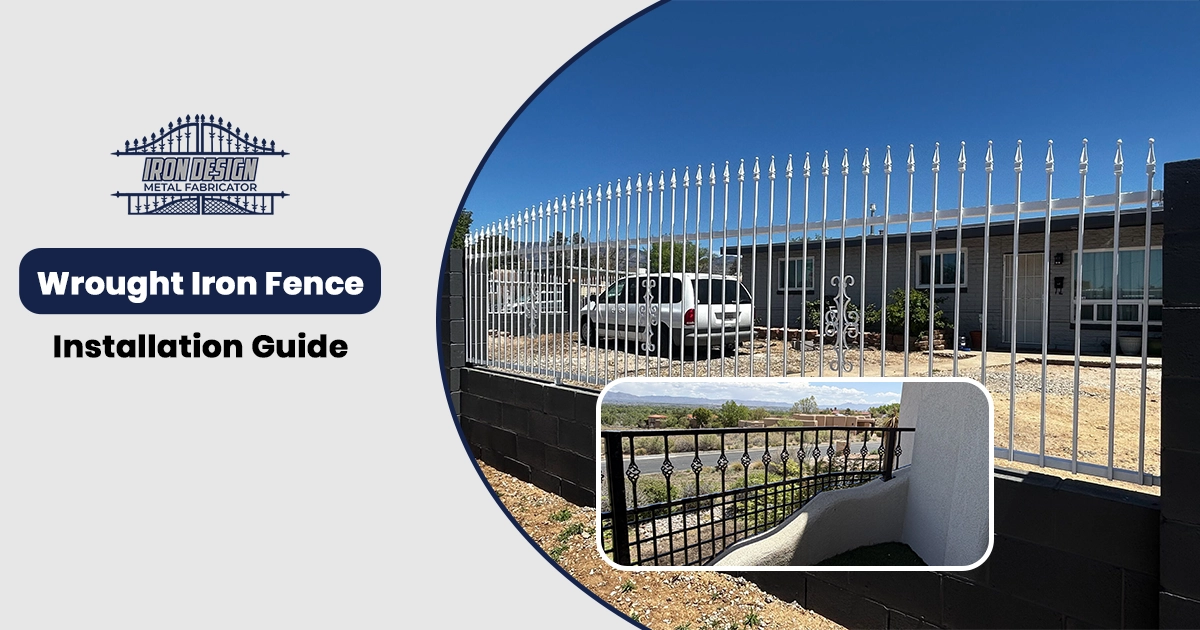
Wrought Iron Fence Installation Guide: Costs, Contractors, Custom Fencing & Gates
If you’ve been comparing fence materials for your Albuquerque property, you’ve probably noticed that a wrought iron fence keeps coming up as the option people don’t regret. It’s not the cheapest fence you can buy, and it’s not the fastest to install but ask anyone who’s owned one for fifteen years, and they’ll tell you it still looks the way it did on day one. That kind of longevity is exactly why homeowners and business owners across the Southwest keep circling back to it.
This guide walks through what a wrought iron fence actually is, what wrought iron fence installation involves from start to finish, realistic costs, how to vet wrought iron fence contractors, and what separates a fence that lasts decades from one that rusts out in five years.
What Is a Wrought Iron Fence, Really?
“Wrought iron” gets used loosely in the fencing industry, so it’s worth clearing up. True wrought iron, hand-forged, low-carbon iron, was the standard material for ornamental ironwork through the 1800s. Today, almost everything sold and installed as “wrought iron fencing” is actually mild steel, shaped and welded to replicate the same scrollwork, pickets, and finials that made the original material iconic.
This matters less than you’d think. Modern iron fencing built from powder-coated steel is stronger, more consistent, and easier to repair than antique wrought iron ever was. When a contractor says “wrought iron,” they almost always mean this modern equivalent, and that’s the product this guide covers.
Why Homeowners Choose Wrought Iron Over Other Fence Materials
Every material has a trade-off. Here’s where iron fencing tends to win and where it doesn’t.
- Longevity : A properly coated and maintained iron fence can last 50+ years, far outlasting wood (10–20 years) and most vinyl.
- Security without a wall :Iron fencing creates a real physical barrier while still letting you see your yard, your street, and your gate, unlike solid privacy fencing.
- Curb appeal : Ornamental scrollwork and finials read as high-end from the street, which is why iron is common on front-facing fences even when the rest of the property is chain-link or wood.
- Low maintenance, not no maintenance : Powder-coated steel needs an occasional rinse and a touch-up if it’s scratched to bare metal, but nothing close to the sanding and re-staining a wood fence demands.
- Cost : This is the honest downside. Iron runs higher upfront than wood or chain-link. Most owners recoup that in avoided replacement and repair costs over 15–20 years.
- Climate performance : In a high-desert climate like Albuquerque’s, with intense UV, dry heat, and occasional hard freezes, iron doesn’t warp, crack, or bleach the way wood and some vinyl products do.
Wrought Iron Fence Installation: What Actually Happens On-Site
A lot of the value in wrought iron fence installation is in the parts you don’t see once the fence is up. Here’s the general sequence a reputable crew follows:
- Site measurement and layout. The contractor walks the property line, marks corners and gate locations, and calls for utility locates before any digging starts.
- Post hole excavation. Iron fence posts need to go deeper than most people assume, typically below the frost line and set in concrete, because the post, not the panels, carries the structural load.
- Setting and curing posts. Posts are set plumb, braced, and left to cure in concrete for 24–48 hours before panels go on. Skipping the cure time is one of the most common corner-cutting problems homeowners run into with unreliable installers.
- Panel and picket installation. Prefabricated or custom-forged panels are secured between posts, then leveled across the full run, this is especially demanding on sloped or uneven Southwest terrain.
- Gate hanging and hardware. Gates are hung, hinges adjusted, and latches or automated openers installed and tested.
- Finish and touch-up coating. Any field welds or cut edges get primed and coated on-site so the finish is uniform and rust-resistant from day one.
A straightforward residential job typically takes one to three days; larger properties, custom wrought iron gate installation, or automated driveway gates can take longer.
How Much Does a Wrought Iron Fence Cost?
Pricing varies by region, design complexity, and gate features, but as a general planning range:
| Component | Typical Price Range |
|---|---|
| Basic iron fence panels (per linear foot, installed) | $30–$75 |
| Ornamental/custom scrollwork panels | $75–$150+ per linear foot |
| Single walk gate | $300–$900 |
| Double driveway gate (manual) | $1,500–$4,000 |
| Automated driveway gate system | $3,500–$10,000+ |
Site conditions move these numbers more than people expect. Rocky or caliche soil (common around Albuquerque), steep grade changes, and long driveway spans all add labor time. Getting a written, itemized estimate, not a rough per-foot verbal quote, is the only way to compare bids accurately.

What to Look for in Wrought Iron Fence Contractors
Not all wrought iron fence contractors operate the same way, and the gap between a good one and a bad one shows up in year three, not day one. Before hiring, ask:
- Do they fabricate on-site or resell prefab kits? A shop that fabricates and welds its own panels can build true custom wrought iron fencing to match irregular lot lines, existing gates, or a specific architectural style, a reseller usually can’t.
- What’s their post-setting method? If a contractor can’t explain frost depth, concrete cure time, and post spacing for your soil type without hesitating, that’s a red flag.
- What coating system do they use? Ask specifically about powder coating versus standard paint. Powder coating bonds more durably and resists chipping far better in high-UV, high-temperature-swing climates.
- Do they carry liability insurance and offer a written warranty? Get both in writing before a deposit changes hands.
- Can they show local work? Photos of fences and gates installed in your actual climate and soil conditions tell you more than a generic portfolio.
- Do they handle repairs, not just new installs? A contractor willing to stand behind repair work on their own installations is signaling confidence in their build quality.
Custom Wrought Iron Fencing: Where It Makes the Biggest Difference
Off-the-shelf panels work fine for a straight, flat lot. But custom wrought iron fencing earns its cost on properties with:
- Sloped or stepped terrain, where panels need to be raked or stepped to follow the grade cleanly
- Irregular lot lines or existing masonry/stucco walls the fence needs to tie into
- A specific architectural style, Southwest, Territorial, modern minimalist, that stock scrollwork doesn’t match
- Combined security needs, like window guards or storm doors that should visually match the fence and gate
Custom work also solves a problem stock fencing can’t: matching an existing gate or railing when you’re only replacing part of a property’s ironwork.
Wrought Iron Gate Installation: Common Mistakes to Avoid
Gates take more abuse than fence panels, they’re the moving part, so wrought iron gate installation deserves extra scrutiny:
- Undersized hinges and posts. A heavy iron gate on an undersized post will sag within a year or two. Gate posts should be sized and set specifically for the gate’s weight, not matched to the fence line posts.
- Skipping a drop rod or ground guide on double gates. Without one, double driveway gates drift out of alignment over time.
- No plan for automation later. If there’s any chance you’ll want an automatic opener down the road, say so during installation, retrofitting is more expensive than wiring for it up front.
- Ignoring swing clearance. Gates need to be measured against real-world obstacles: parked cars, slopes, and sidewalks, not just the flat blueprint distance.
Maintaining Your Iron Fence After Installation
A wrought iron fence is low-maintenance, not maintenance-free:
- Rinse off dirt, pollen, and salt buildup a few times a year.
- Touch up any scratch down to bare metal promptly, exposed steel is where rust starts.
- Lubricate gate hinges and latches once or twice a year.
- Check post bases annually for any cracking in the surrounding concrete or soil erosion around footings.
Frequently Asked Questions
Is wrought iron fencing worth the cost compared to wood or vinyl?
For most homeowners planning to stay in a property long-term, yes. The higher upfront cost is typically offset by avoiding the replacement cycles wood and vinyl fencing go through every 10–20 years.
How long does wrought iron fence installation take?
A standard residential fence usually takes one to three days. Custom fencing, long driveway runs, or automated gates can extend that timeline.
Can an existing wrought iron fence be repaired instead of replaced?
In most cases, yes. Rust spots, bent pickets, and sagging gates can usually be repaired if the underlying posts are still structurally sound.
Do wrought iron fences rust?
Modern powder-coated steel fencing is highly rust-resistant, but any bare-metal scratch or chip left untreated can eventually rust. Prompt touch-ups prevent this.
What’s the difference between wrought iron and mild steel fencing?
True wrought iron is a specific low-carbon material rarely produced today. Nearly all modern “wrought iron” fencing is actually mild steel fabricated to replicate the traditional look, with better strength and consistency.
Get a Local Estimate
If you’re in the Albuquerque, Rio Rancho, Santa Fe, Bernalillo, Los Lunas, Belen, or Gallup area and you’re ready to talk through iron fencing, custom gates, or a repair, Iron Designs fabricates and installs on-site rather than reselling prefab kits, which is exactly the kind of contractor this guide recommends looking for. You can reach us at 505-357-7161 or through our contact page for a written estimate.
